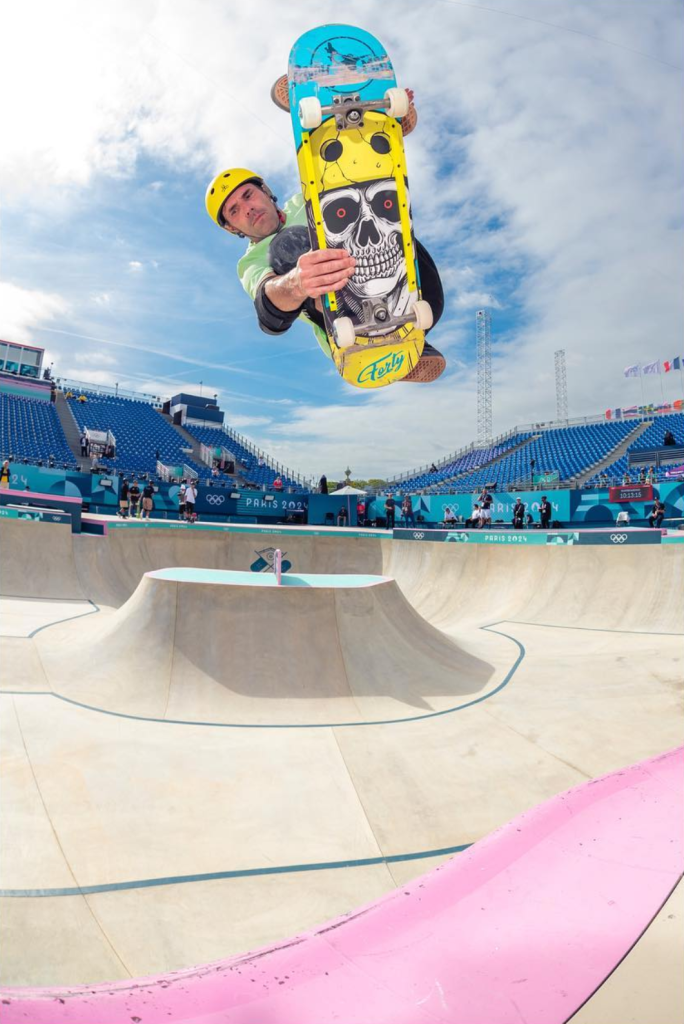
Andy MacDonald / BS Indy / P: Garry Jones
Before I begin, I just want to give a very special shout out to my mate Garry Jones - Garry is Coventry born and bred, and has been a firm staple of the skate scene in the city for years, having collaborated with me to take photos for this very blog in this past. He's gradually grown into one of the most high profile photographers not only within skateboarding, but even outside of skateboarding, being the go to photographer for the recent Labour campaign which saw Kier Starmer become Prime Minister. He's done extremely well for himself, and the photos you see in this post are some of his excellent work from the 2024 Olympics. Proud of ya, Garry!
So, it’s 2024, and that means it’s time for the Olympics. It’s been 3 years since I last posted anything related to the Games, and I’m gonna be honest, the novelty for me quickly worn off. I’m not a fan of more “sports” style coverage of skateboarding – I’ve never really been into SLS, or the X-Games, or any other equivalent high budget extreme sports fare, and that includes the Olympics. I’m all for the added spotlight it gives to skateboarding though, and I like that it buys us some more fans who may have been extremely likely to kick us off spots, or argue that we don’t need a new skatepark.
The thing is, as we are likely to do, there’s a lot for British skateboarders to be frustrated about still. Perhaps this is just me being a broken record, because my last Olympics post covered some of the same ground. But there is, in particular, 3 things that I want to cover, and they all have the same root cause.
1. Team GB (and USA)
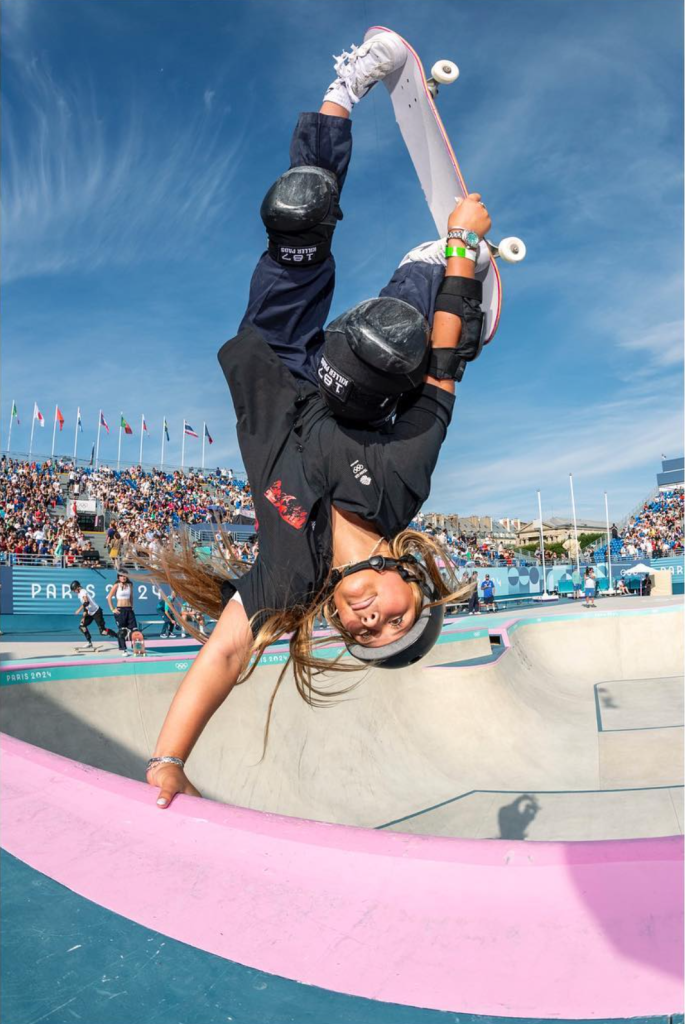
Sky Brown / Handplant / P: Garry Jones
For a country with a huge, thriving skate scene, we still seem overly reliant on using American pro skaters to bolster our team numbers. It’s been the topic of great debate on social media: Do Sky Brown and Andy MacDonald count as “British Athletes” just because one of their parents is from Britain? This was ultimately the crux of the last Olympics, with various American pro skaters sneaking into teams from Europe by way of heritage, like Lizzie Armanto joining the Finnish team. How global is skateboarding as a legitimate Olympic event, if one country can basically dominate the conversation by having their extremely experienced pro skaters take spots on other countries teams?
The truth is, this was always going to happen. America is the birthplace of skateboarding. It’s where the skateboarding industry emanates from. Someone who has grown up skating perfect concrete parks in California, where skateable terrain is in abundance on their doorstep, is going to have a better chance at getting noticed by the Olympics than someone who grew up on cobbled streets in Yorkshire, where their local was a tin can mini ramp. That’s just reality, and partially explains why the athletes who hold American passports have a better time qualifying than their British team mates: Bombette Martin qualified in 2021, Andy Mac qualified this year, and Sky Brown has qualified in both 2021 and 2024.
Lola Tambling is the only “British” skater to qualify in this year’s games, and she is someone who has lived and breathed skateboarding her entire life, growing up in skateparks, with a Dad who was already engrained in the scene. It speaks to the culture difference between Britain and America, where skateboarding is far more encouraged. It also speaks to the culture of skateboarding.
The UK has produced prominent, big name legends in skateboarding, who became just as well known in the US, even bagging sponsorship deals with big name US companies: Geoff Rowley, Ben Raemers and Tom Knox (the British one) just to name a few. It isn’t outside of the realm of possibility for us to build a team of homegrown talent – however the competition circuit isn’t the goal of many skateboarders. The names mentioned above were not the competition type, they were more traditional pro skaters who film parts, innovate in other ways, and got their recognition through filming amazing tricks on the street. Even the late, great Ben Raemers, known for his phenomenal prowess in a skatepark, was equally amazing on the street.
By the numbers, it’s going to be obvious that only the USA has the sheer number and breadth of skateboarders who could fill the scoreboard of an Olympic sized competition alone. The number of competition skaters from America far outweighs our own, and most skateboarders are too busy concentrating on the “core” vision of skateboarding, rather than the “sports” version of it that the Olympics represents.
Basically, skateboarding’s identity is at odds with the Olympics.
2. The Culture Of Skateboarding
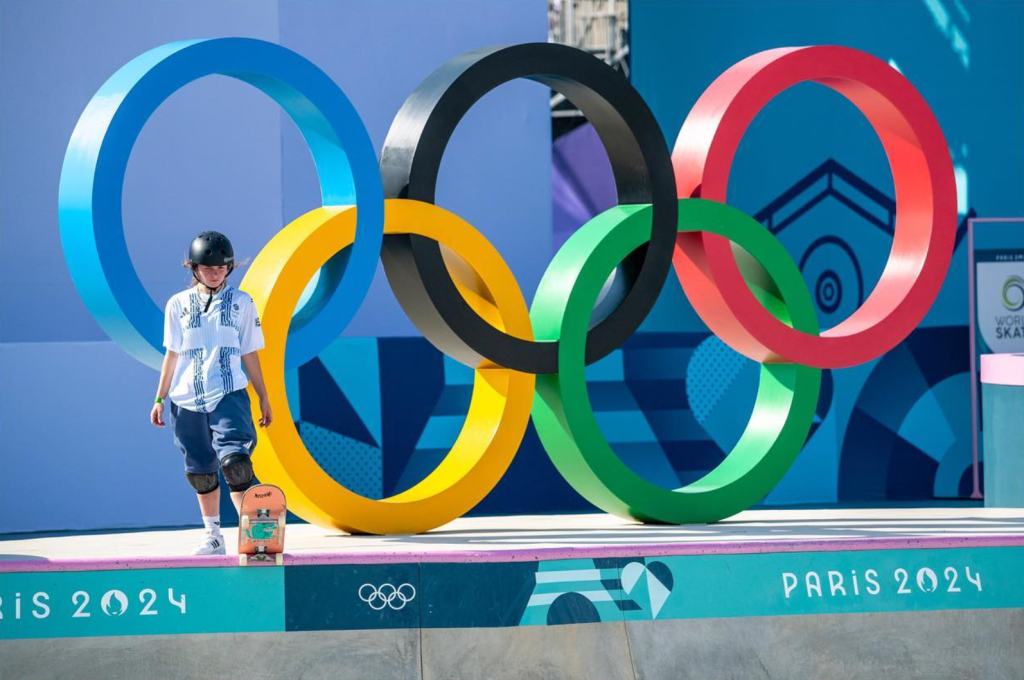
Lola Tambling getting ready to drop in / P: Garry Jones
As mentioned above, the Olympics has this clean, sports like presentation. When I think of skateboarding, and I think of how I got into it, I think of rebellion, I think of aggression, and I think of dirty, nasty, skate spots that stink of piss. To many Brits, that is the norm: skating your local spots, hidden away in the crevices brutalist UK Architecture, in weird little pockets where drug addicts used to hang out, until you came barrelling in with your loud wooden children’s toy, and turned it into a haven of creative expression.
Even in the UK/US divide, many Americans, especially in California, will tell you of the time they hopped into someone’s garden, trespassing to skate a backyard pool. I spent last Sunday skating a busy stretch of road near Coventry train station, dodging taxis to slappy a curb. The TV presentation of skateboarding in the Olympics, and what we do as average skateboarders, is so much farther removed than even what Sunday football clubs get up to when compared to Premier League teams.
This is perfectly encapsulated by something I said in conversation with my Mum. She had been watching the Olympics, and she is perhaps the most unbiased person to comment, considering she is both aware of the Olympic side, but also has been witness to my various dirty, grimy videos of locals skating back alleys for years. She was impressed with Andy Mac, and was excited to see it on a big stage – but when she asked for my opinion on it, all I could say was: “I’ve never been into the “competition” side of skateboarding. I prefer the “daft idiots mucking around in the street” aspect.”
I have been known to talk about “relatable” skateboarding. For example, the idea of watching Nyjah Huston perform a perfect Front Smith down a 20 stair handrail does nothing for me. I can’t relate. I can’t even ollie onto a handrail, let alone ride it for that long. Actually, from what I see, that level of skateboarding is nigh on impossible for many. In my eyes, it’s too good. I can appreciate it for what it is: the pinnacle of skateboarding athleticism. And that’s the thing. That “athleticism” part. Skateboarding is exercise, and it is “athletic”, but I struggle to call skateboarders “athletes”.
We’re performance artists. We’re not getting our Sunday uniform on for a kick about. We’re not prepping for a 5k run. We express ourselves using the skateboard as our brush, and the architecture as the canvas. I can’t relate to Nyjah’s perfectly executed 20 stair handrail trick because it’s perfect, and skateboarding isn’t perfect. Skateboarding is sketchy, mach-10 downhill lines where you feel like you’re about to see someone eat shit. I would prefer to watch T-Funk ollie on the china banks over and over than see the variety of acutely practiced, expertly performed tricks at the Olympics, and I feel like many skateboarders have the same opinion.
Basically, skateboarding’s identity is at odds with the Olympics.
3. Public Perception
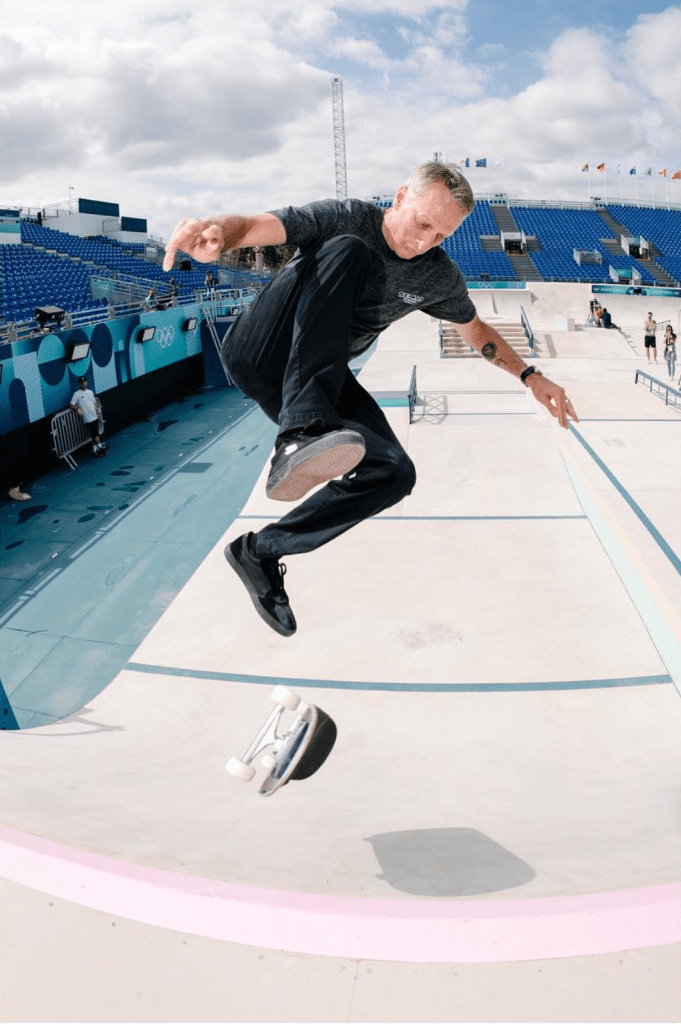
Tony Hawk / Tre Flip / P: Garry Jones
The final thing here is the way the public approaches skateboarding in the Olympics. I touched on it earlier, and many non-skaters are interested in what we have to offer, and are rallying around stories like “51 year old Andy MacDonald is in the Olympics”. As with everything, whenever there is a mainstream skateboarding thing, we are inundated with messages from well meaning non-skater friends who send us a link to Andy Mac or Sky Brown, or Tony Hawk doing a tre flip on the Olympic course (a photo taken by A GUY I ACTUALLY KNOW), sharing it to us like this is new information we had no idea about. “Hey Ade, saw this and thought you might be interested” – Thanks, I clearly had no idea an activity I have participated in for half of my life was getting this level of mainstream coverage.
Sorry, I’m being a dick.
These people mean well, and they only share it as a means to reach out and connect. Many of these people are friends I have known for years, and are people I respect. This goes hand in hand with the culture of skateboarding though: We are ill prepared for this level of scrutiny, and we have all spent so much of our lives living, breathing & sleeping skateboarding that the minute “normal people” approach us about it, it feels like our safe space is being invaded. For years, nobody cared about it, or they thought we were weird for being so obsessed with a plank with wheels. Suddenly, everyone wants to talk to us about it and hear our thoughts on “which team is gonna win the gold medal”.
I’m not a sports guy. I’m impressed by artistic and creative aspects of athleticism, where people push their craft in unique and interesting ways. I enjoy watching Ben Koppl do crazy tailblock and blunt variations that I’ve never seen before. The nearest thing I get to watching any sorts of sports program is professional wrestling, and I watch that for the storytelling and theatrical nature of it. I enjoy seeing Jacob Fatu launch himself 10 metres from a turnbuckle through an announcers table. I’m only saying this because I want to mention Professional Wrestling… But you get the idea. I like stunts. And stunts aren’t perfect. Stunts are dangerous, they are wild, and they aren’t particularly “sporting”.
I like seeing these things where you can look at an object, and the person using it can do 50,000 different things with it depending on their style. A skateboarder can look at a ledge, and do a Switch Krooked Grind, or a No Comply Bluntslide, or a Nosebonk over it, or a Tre Flip Manual, or a Wallie Boardslide. This isn’t the same as many other sports, where you “win” by getting more points than the other person. There are “points” in skateboarding, and even when there are, it’s all subjective. As I said above, it’s an artform.
This is why it riles me up when people say “The skateboarders aren’t very good”. How do you quantify “good”? How does someone who doesn’t skateboard quantify “good”? People who do not skate have no barometer for trick difficulty. I can tell you a Smith Grind is harder than a 5050, because I can 5050 but I cannot Smith Grind – but if you can’t do either how do you know? This is abundantly clear in the perceived odd scoring of the men’s street competition, where Yuto Horigome came away with his second gold medal with a trick that had the skateboarding community divided. It’s all down to personal preference from the judges, which is hard to justify for an artform.
And so, when people see Yuto’s winning Nollie 270 Blunt (spun “the wrong way”) on a handrail, an admittedly impressive trick that is rarely seen, especially in a competition setting, and claim it “looked easy”, I can’t help but feel frustration. “They spent more time falling off than landing stuff” – says the man who has never skated in his life. “Give me a year and I could do that too” – says the woman who would likely faceplant even looking at a mini ramp. The Dunning Kruger Effect around skateboarding is the reason why skateboarders keep themselves to themselves. The frustration I feel seeing these comments matches the frustration I felt sitting in a council meeting where a woman questioned whether skateboarding “was actually exercise”. The Olympics has exposed us to a huge group of people who don’t know what they are talking about telling us this extremely difficult thing we have spent years doing and practicing is “easy”.
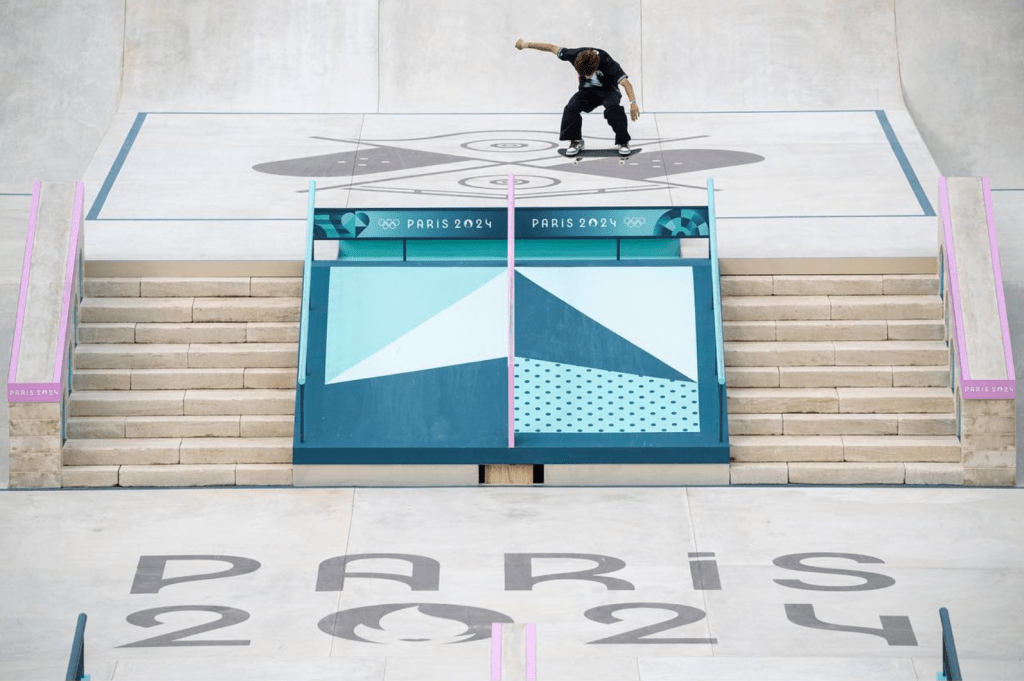
Yuto Horigome making it look easy / P: Garry Jones
Even with this being the second time skateboarding has appeared at the Olympics, we’re still seeing the BBC Sports posts around it flooded with posts like “Why is this in the Olympics?”. I would likely ask the same question, although my perspective comes from a love of the artform, and a desire to not see it treated more as I see it, rather than a “sport”. The people asking these questions don’t ask out of love, though – they think skateboarding is dumb, they don’t like it, and they don’t want it on their TV.
I think back to Noel Gallagher’s ridiculous comments about it: “Who’s winning the gold? Bart Simpson?”. It might sound pretentious, but skateboarding is too good for these people. Why are we spending our time trying to entertain them, when the only ones who need to enjoy skateboarding are skateboarders? You can try and explain that Gymnastics, another “artform” where the execution and style of moves is the main criteria for judging, is also an Olympic sport – but funnily enough they can’t draw the parallel and don’t see that as an apt comparison.
Still, I will admit the positives outweigh the negatives. Every time the Olympics rolls around, we see renewed interest, and more excuse for more skateparks, skateboarding events, and more investment in our industry. As long as skateboarders get to keep doing what they enjoy, that’s surely a good thing. However, the public perception of skateboarding has just descended into a lot of misinformed sports commentary, and people who never liked skateboarding complaining that it’s in the Olympics.
Basically, skateboarding’s identity is at odds with the Olympics.
OK, I get it. Skateboarding’s Identity is at odds with the Olympics.
Let’s point out the facts here.
World Skate, the body responsible for the Olympic Skateboarding competition, exists primarily to promote artistic rollerskating, and is, at time of writing, headed up by a rollerblader.
The Olympics included skateboarding, and freestyle BMX, as an attempt to attract a younger audience. As with everything, this is about increasing capital and making more money for the Olympic committee.
The Men’s Street competition this year had to be rearranged, because nobody thought to consider than rain (which is quite common in Paris) might make a skatepark dangerous and slippery. It seemed nobody considered having the Olympic Skatepark built inside.
The coverage of the skateboarding has failed to explain certain nuances of skateboarding, leading to a lot of confusion and flippant handwaving by the general public.
Listen, I can’t sit here and slag off the Olympics, especially when it’s given people like my mate Garry Jones opportunity to show off his artistic credentials as a photographer. As I said, the inclusion of skateboarding is a positive for how we are perceived, and as we are “normalised”, it means people see us as less of a nuisance. People like Andy Mac competing will also do wonders for dealing with those dickhead parents who treat older skateboarders like a problem at skateparks – if we are seen as “future Olympians”, they have less of a leg to stand on when they start arguing with us over how a skatepark should be used.
I think my issue here is that, on a ground level, the Olympics isn’t really benefitting skateboarding long term. Zeroing in on Coventry, we are still in a battle to get a top tier, state of the art skatepark (embarrassingly, now closing in on being the longest running skatepark campaign). We’re still relying on a local skateshop to provide all lessons to a vastly growing audience of young kids who want to learn to skateboard, with very little council backing or funding. It’s still the local skaters doing all the work.
When the Olympics wanted skateboarding, skateboarding stepped up. We offered our best competition skaters. We collaborated with those who do not skateboard. Skateboarding adapted itself, bent itself, to ignore the quirky art weirdos and present itself as a “sport” with “athletes”. Countries attracted top tier talent through strange loopholes to get big name US pro skaters to fill out their ranks. So, when is the Olympics going to pay back the favour?
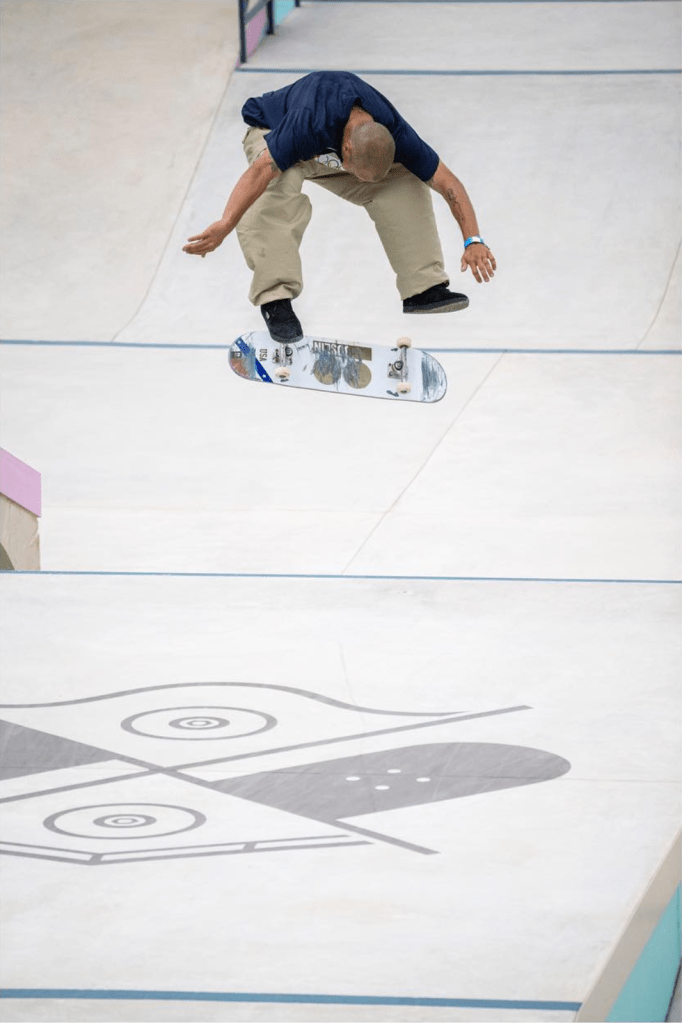
Chris Joslin practicing for the Street Comp / P: Garry Jones
And it’s not just the Olympics. They Olympics can only go so far in crowing about the new sports they want to cover. They can only supply the opportunity. But the countries competing need to meet them halfway, and Britain has failed to do so.
The reason why Britain struggles to offer up any skateboarders who can compete with Sky Brown and Andy Mac, is because Britain has this outdated attitude towards skateboarding. A country that is serious about Olympic Skateboarding wouldn’t be giving Bendcrete or Rhino Ramps contracts to build skateparks. If we were serious about this, we would be investing in Betongpark, Canvas, Wheelscape, Acrete, and other top park builders. We would be aiming to match Japan’s skateparks, to breed an army of Yuto Horigome clones.
The proof is in the pudding. TeamGB skaters who live in Britain are less likely to qualify than those who grew up skating Californian skateparks. If that’s not enough reason to build bigger, better skateparks, then there will never be a reason that is good enough. This is exacerbated by SkateboardGB’s focus on specific areas like Derby and Nottingham area – where they seem to get more funding for top quality skateparks and skateboarding initiatives, whereas areas like Coventry flounder.
Many would say that “the scene isn’t big enough in Coventry compared to Derby/Notts”, but I would argue that, Coventry’s scene is massive, and the scene up North only improved further from serious investment in local skateparks, local skateboard businesses, and having industry heads on the ground (including those involved with SkateboardGB), pushing the local authorities to provide that foundation.
The truth is that skateboarding just doesn’t get enough love from outside of our own sphere. If SkateboardGB were given more backing to support the blind spots like Coventry, this wouldn’t be a problem. As a country, we are still so hyper-focussed on traditional sports like football, that we fail to see how more creative pursuits like skateboarding could be a benefit to many young people.
So, whilst it’s great that Andy Mac, a 51 year old man who resides in the US, and has achieved practically everything in Vert Skateboarding, gets to check off “compete in the Olympics” from his bucket list, alternatively, as far as I’m concerned, the average skateboarder hasn’t really seen much change or improvement in their local scene. Change is slow, and progress is slow, but I don’t want to be the same age as Andy Mac before I see Coventry get the skatepark it truly deserves. Maybe it just comes across as bitter that I’m just sat here saying “The Olympics should be making things better than they are”, but the dream we were all sold when skateboarding was brought into the Games was better than “the same as it ever was”.
Let’s hope things are better in 2028.


Leave a comment